



From pod to bar, every stage of our chocolate
Between the plantation in Ben Tre and our shops, a bean passes through many hands, and through many boxes, racks, sacks and machines. Here is every stage, in order.
Chapter I
In Vietnam


Stage 01
Harvest
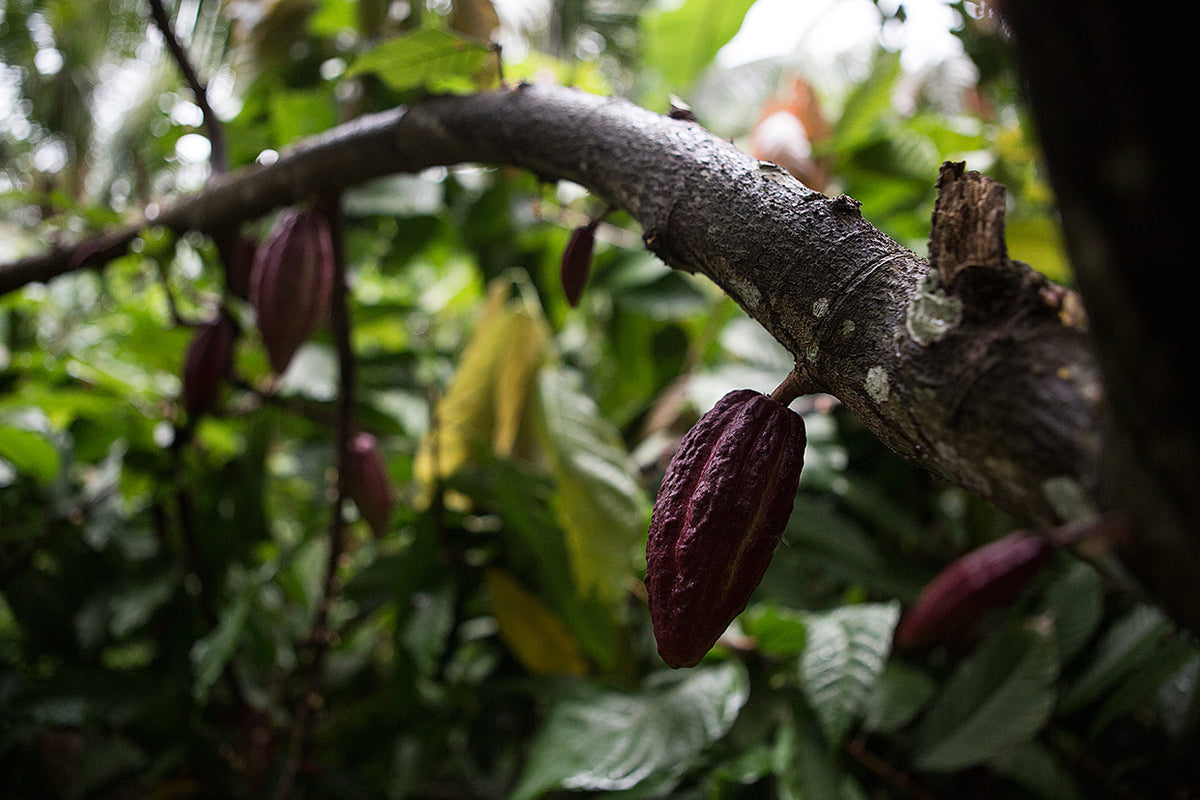
A ripe pod has vivid, glossy colours. If it is dull and sounds hollow, it is overripe. To check, we open 1 pod in 20 and measure the sugar in its juice with a must meter, the same tool winemakers use. Above 126 g/L, the harvest can begin.
Stage 02
Resting the pods
When the juice lacks sugar, the pods wait 3 to 4 days in the shade. They lose around 8% of their weight and their sugar becomes more concentrated.
Stage 03
Pod opening and sorting
The pods are opened, sorted by type and ripeness, then divided into numbered batches. The empty husks are buried in a 40 cm pit, beneath a layer of lime: left in the open air, they would attract fungi. Buried, they return their potassium to the soil.
Stage 04
Filling the boxes
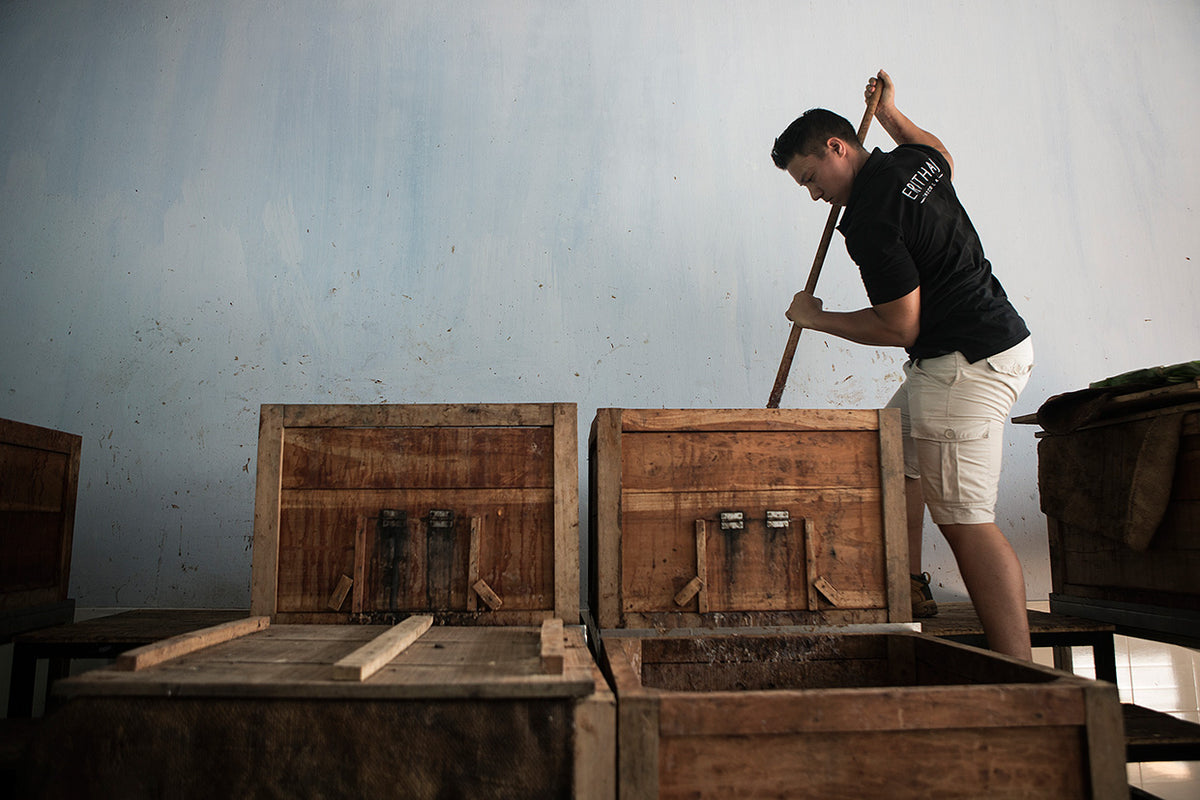
The beans, still coated in their pulp, are poured 60 to 70 cm deep into boxes made of resin-free hardwood. The base is pierced every 15 cm to let the juice run off. Chopped young leaves of banana, cassava or mandarin act as a natural starter. For 48 hours, a lid of the same wood rests on the beans.
Stage 05
First turning, at precisely 48 hours
The beans are turned by hand for around 20 minutes, corners included, then transferred into the next box. The boxes are stacked in tiers on a stainless-steel frame mounted on wheels: the beans pass from one box to the next by gravity alone.
Stage 06
Second phase
The box stays open, under mosquito netting. A second turning takes place 48 hours later, when the mass approaches 50 °C. At each turning, we measure the temperature, the pH and the sugar. In all, fermentation lasts 5 to 6 days. Read our chronicle on fermentation.

Stage 07
Collecting the juice
The juice that runs from the boxes is collected to make our syrup and our cacao vinegar. In 2017, a first 12 kg batch, marked “XIRO”, showed that the pulp could be drawn off without disturbing fermentation.
Stage 08
Sun drying
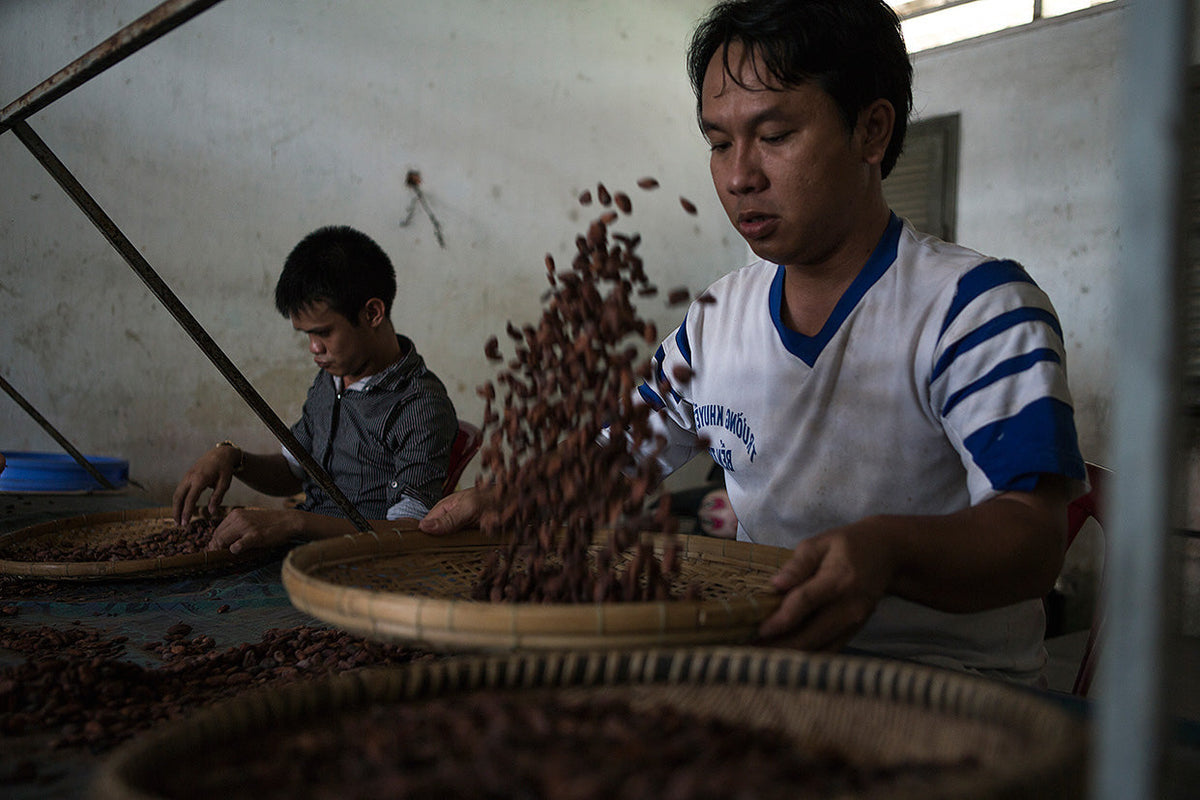
The beans are spread on ventilated racks, in a layer no more than 5 cm deep, for 5 to 8 days, until they reach 6 to 7% moisture. The difference in temperature between day and night makes the bean “breathe” and drives out the remaining acidity. When it rains, drying continues beneath a transparent tarpaulin fitted with a chimney.

Stage 09
Quality control
This is the cut test: 100 beans are cut in half and the colour of each one is examined. In our current batches, 95% of the beans are well fermented.
Stage 10
Sorting, cleaning, bagging
The beans are sorted into large and small, cleaned, then packed into 40 kg jute sacks. 520 kg of fresh beans yield around 230 kg of dried beans, then 204 kg once cleaned.
Stage 11
Shipping
The sacks leave the port of Ho Chi Minh City and travel by container to Le Havre. The container then reaches Alsace by lorry.
520 kg of fresh beans, 204 kg of beans ready to become chocolate.
Chapter II
In France
Stage 12
Unloading and storage in Illkirch
The container is unloaded in Illkirch. The sacks, loaded loose, are taken off and stored on site, in our main stock. The batches are the same as in Vietnam.
Stage 13
Processing at A. Morin (Drôme)
The beans are processed to our recipes: roasting; winnowing to remove the shells; grinding, which turns the bean into cocoa mass; the addition of sugar, with little added cocoa butter; then conching, which refines the texture. The couverture comes back to us in blocks or in disc-shaped pistoles. Read our chronicle on chocolate making.
Nothing goes to waste: the bean fragments become our cocoa nibs, and the shells our cocoa infusion.


Stage 14
Back to the Plobsheim workshop
There the couverture is tempered, moulded or used for enrobing. The creations are unmoulded, then left to crystallise for around a week before being wrapped.
Stage 15
In our shops
From bean to bar, every stage comes together in our shops in Strasbourg and Plobsheim.